What is the Milky Way?
A city of stars, gas, dust and dark matter, and the only galaxy we will ever see from the inside.
How this site works. Every fact is in our own words and linked to its source, beside it. Where good sources disagree, we show each version in a “Sources differ” box.
Our galaxy
The Milky Way is the galaxy we live in: a huge collection of stars, gas, dust and dark matter, all held together by gravity. Royal Observatory
It is a large barred spiral galaxy. NASA Imagine
Every star you can see in the night sky is part of our own Milky Way. NASA Imagine
Based on the deepest images so far, ours is one of about 2 trillion galaxies in the observable universe. NASA, how big
Why “milky”?
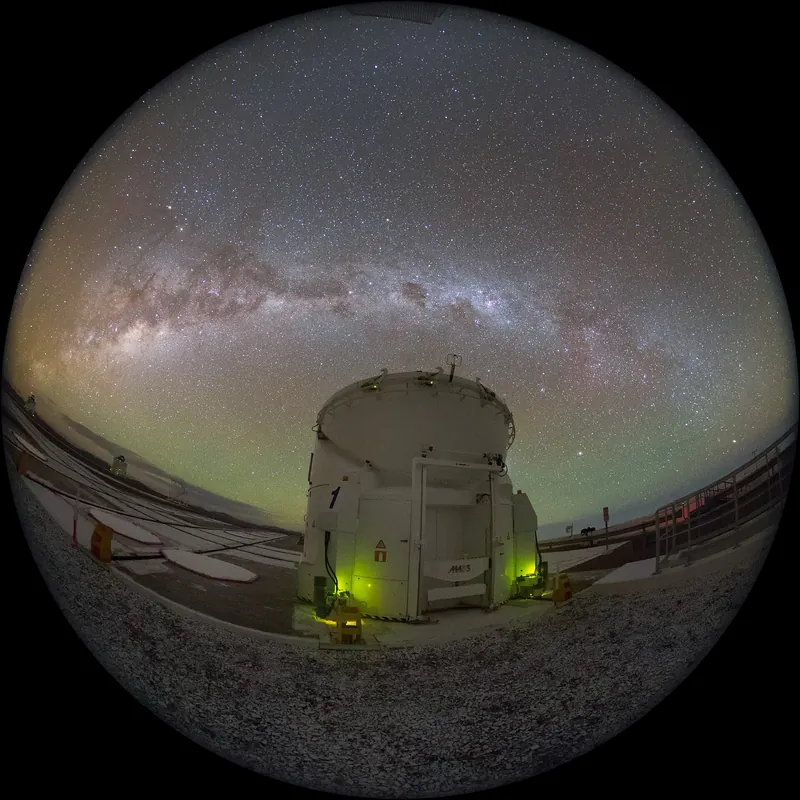
From Earth it looks like a faint, milky band of light arching across the whole sky, which is how it got its name. NASA, galaxies That band is the galaxy’s central disc, seen edge on from inside. NASA, galaxies
Seeing the stars in one band, rather than spread all round the sky, tells astronomers our galaxy is basically flat. NASA Imagine
Our word ‘galaxy’ comes from the Greek ‘galaxias’, meaning ‘milky’. Royal Observatory
How many stars?
Counting the stars is very hard because we are inside the galaxy. NASA Imagine
How many stars? Sources differ
- NASA says our galaxy probably contains 100 to 400 billion stars. NASA, how big
- ESA’s guide puts it at about a hundred billion stars. ESA, guide
- Britannica says several hundred billion stars, one of which is the Sun. Britannica
Nobody can count them all from inside, so each figure is an estimate. NASA’s range covers both of the others.
The Royal Observatory estimates 100 to 400 billion planets too. Royal Observatory
How big?
How wide is the Milky Way? Sources differ
- Royal Observatory: approximately 87,000 light-years wide, measured to a set level of brightness (the “isophotal” diameter). Royal Observatory
- NASA: about 100,000 light-years across. NASA, how big
- NASA’s galaxy page says its disc of stars spans more than 100,000 light-years. NASA, galaxies
- Britannica’s summary: roughly 150,000 light-years in diameter. Britannica, summary
A galaxy has no hard edge, so the width depends on where you decide it stops. The Royal Observatory’s figure is measured to a set brightness; the others are rounder figures.
A light-year is the distance light travels in a year: about 9.5 trillion kilometres. NASA, how big
The disc is only about 1,000 light-years thick at the spiral arms, rising to around 10,000 light-years at the central bulge. Royal Observatory
ESA describes the star disc as having a radius of about 50,000 light-years but a height of only 1,000 light-years. ESA, guide
How old?
How old is it? Sources differ
- The Royal Observatory gives its age as roughly 13.6 billion years. Royal Observatory
- ESA’s Gaia team says about 13 billion years. ESA, Gaia 2018
Both are estimates of the age of the galaxy’s oldest parts, and they are close.
Mostly invisible
A roughly spherical halo of dark matter about a million light-years wide provides 90% of the galaxy’s total mass. Royal Observatory
Until dark matter is pinned down, the total mass can’t be measured: it is at least several hundred billion, and possibly a trillion, times the Sun’s. Britannica, structure
Its precise shape, true size and mass are still not known. Britannica, summary
Mapping it from inside
A thick layer of dust hides much of the galaxy from ordinary telescopes, so astronomers map it with radio and infrared telescopes. Britannica
No spacecraft has gone far enough to photograph the Milky Way from outside, so every picture of the whole galaxy is an artist’s impression or a data map. Royal Observatory
Our view: we are trying to draw a map of a forest while standing in the middle of it, in the fog. It is remarkable how much we know.
Next: the arms and the bar →