The heart of the Milky Way
A crowded, dusty middle, with a black hole of four million Suns.
How this site works. Every fact is in our own words and linked to its source, beside it. Where good sources disagree, we show each version in a “Sources differ” box.
Hidden by dust
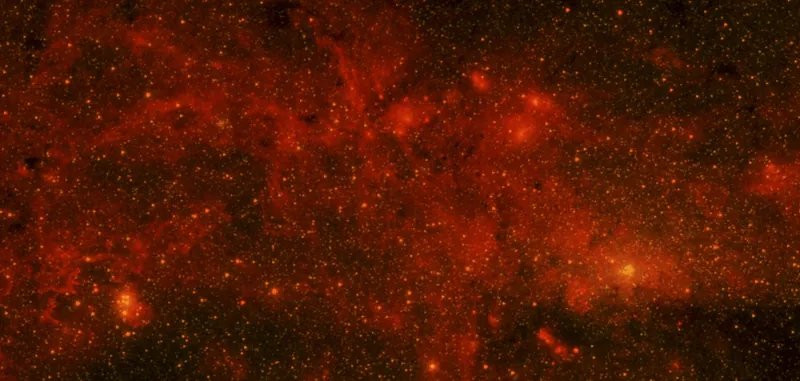
In ordinary visible light the centre can’t be seen at all: dust between us and it blocks the view, but infrared light gets through. NASA JPL
A Spitzer infrared picture shows hundreds of thousands of stars crowded into the centre. NASA JPL
Sagittarius A*
At the heart of the bulge sits the supermassive black hole Sagittarius A*, with the mass of four million Suns. Royal Observatory
How far away is it? Sources differ
- ESO puts the black hole about 27,000 light-years from Earth. ESO, 2022
- NASA puts it 26,000 light-years away, and says there is no danger of Earth being pulled in. NASA, 10 questions
Both are round numbers from very good sources. The difference is less than four per cent.
From that distance it looks about as big in our sky as a doughnut on the Moon. ESO, 2022
Stars have been seen orbiting the black hole as close as a few light-days. ESA, guide
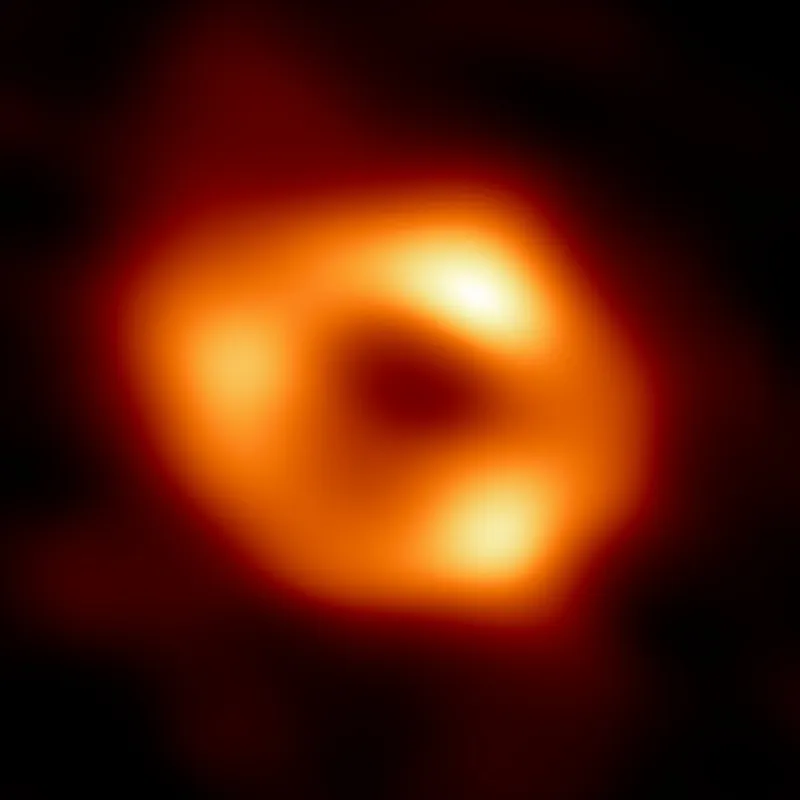
There is much more on Sagittarius A*, the black hole at the centre on our sister site, black-holes.galaxies.im.
A busy neighbourhood
A few hundred light-years from the black hole, a ring of giant gas clouds, the Central Molecular Zone, holds the galaxy’s densest gas. Royal Observatory
The bar pulls gas from the arms and funnels it in towards the centre. Royal Observatory
The central bulge holds about ten billion mainly old, red stars and is shaped like a peanut. ESA, guide
Our view: the most exciting place in our galaxy is one we cannot see with our eyes at all. Infrared telescopes are the night-vision goggles of astronomy.
Next: the neighbours →