Picture credits
The drawings are our own. The photos are from Wikimedia Commons, under Creative Commons licences (Attribution, or Attribution-ShareAlike), CC0, or in the public domain.
Photos
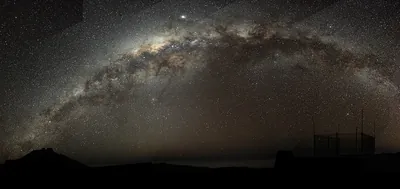
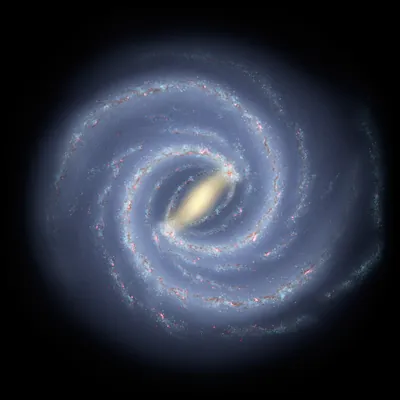 Artist’s impression of the Milky Way.jpg
by NASA/JPL-Caltech/ESO/R. Hurt, Public domain. Cropped and resized; no other changes.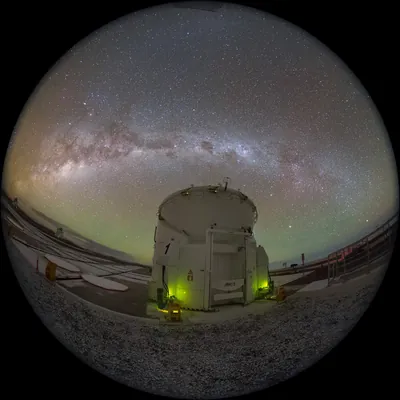 Milky Way slice (beletsky-paranal-25-cc).jpg
by ESO/Y. Beletsky, CC BY 4.0. Cropped and resized; no other changes.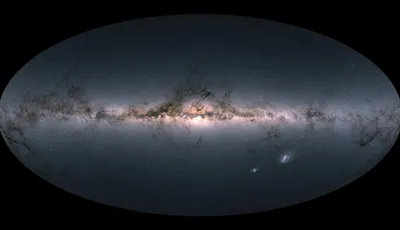 Gaia's all-sky view (ESA Gaia DR2 AllSky Brightness Colour black bg 8k).jpg
by ESA/Gaia/DPAC, CC BY 4.0. Cropped and resized; no other changes.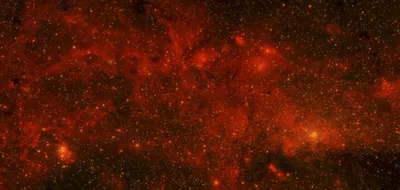 Center of the Milky Way Galaxy I – Spitzer (Infrared).jpg
by NASA/JPL-Caltech/ESA/CXC/STScI, Public domain. Cropped and resized; no other changes.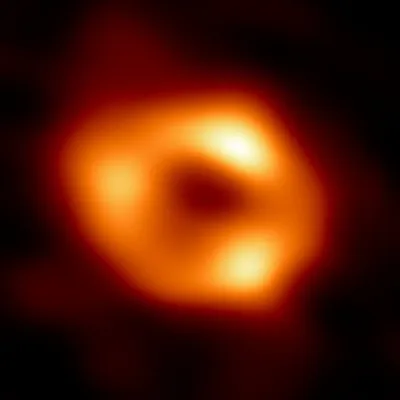 First image of our black hole (eso2208-eht-mwa).jpg
by EHT Collaboration, CC BY 4.0. Cropped and resized; no other changes.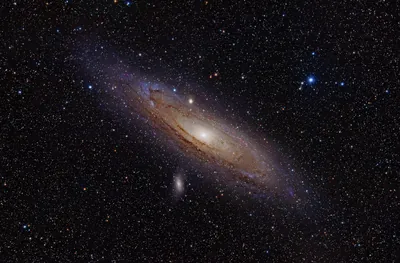
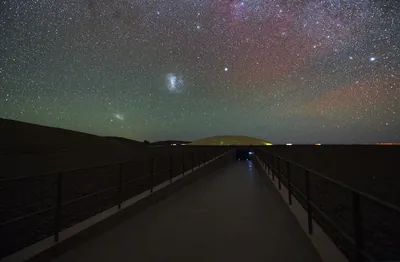 Magellanic Clouds at Paranal (beletsky paranal 10f).jpg
by Y. Beletsky (LCO)/ESO, CC BY 4.0. Cropped and resized; no other changes.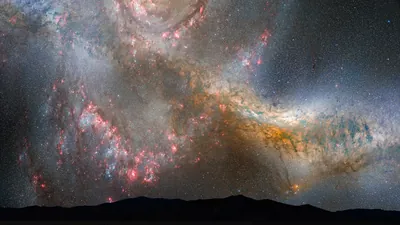 Nighttime Sky View of Future Galaxy Merger- 3 85-3 9 Billion Years (2012-20-3035).jpg
by NASA, ESA, Z. Levay and R. van der Marel (STScI), T. Hallas and A. Mellinger, Public domain. Cropped and resized; no other changes. Justus Sustermans - Portrait of Galileo Galilei (Uffizi).jpg
by Justus Sustermans, Public domain. Cropped and resized; no other changes.
Our own drawings
- A simplified drawing of the Milky Way seen from above: a pale yellow bar across the middle, a glowing centre marked Sagittarius A*, two thick blue spiral arms (Perseus and Scutum-Centaurus) and two thinner purple ones (Sagittarius-Carina and Norma/Outer). A gold dot about halfway out marks the Sun near the small Orion Arm, with a dotted line to the centre labelled about 26,000 light-years.
Our own drawing - A side view of the Milky Way: a long, very thin bright disc with a fat oval bulge in the middle, a gold dot for the Sun about halfway out along the disc, and scattered dots in a dashed oval around it all for the stellar halo and its globular clusters.
Our own drawing - A bar chart of galaxy widths in light-years: the Milky Way 87,000 (Royal Observatory, isophotal), 100,000 (NASA) and 150,000 (Britannica summary); Andromeda 152,000 (Royal Observatory) and 220,000 (NASA).
Our own drawing - A drawing of nearby galaxies: the Milky Way on the left with three small companions, the Sagittarius dwarf, the Large Magellanic Cloud (163,000 light-years) and the Small Magellanic Cloud (202,000 light-years); a dotted line labelled 2.5 million light-years leads to the larger Andromeda galaxy, with the smaller Triangulum galaxy below it.
Our own drawing - A drawing of a winter night sky: a pale band of the Milky Way arches from the constellation Orion on the left, past Gemini and the W shape of Cassiopeia, down to the north-west horizon on the right.
Our own drawing - A vertical timeline: ancient Greece, Democritus suggests distant stars; 1610, Galileo sees stars; 1750, Thomas Wright’s flat layer of stars; 1755, Kant’s island universes; 1780s, Herschel counts stars; 1917, Shapley shows the Sun is far from the centre; 1920s, other galaxies confirmed; 1950s, Oort maps spiral arm hints by radio; 2005, Spitzer proves the bar; 2018, Gaia charts nearly 1.7 billion stars; 2025, Andromeda collision only 50-50.
Our own drawing
The drawings are simplified teaching drawings, not to scale, made from the sourced descriptions on this site. Useless the eraser is the network’s own mascot. Fonts: Bricolage Grotesque, Newsreader and Kalam (SIL Open Font Licence), served from this site.