The shape of our galaxy
A bar in the middle, spiral arms coming off it, and a halo of old stars all round.
How this site works. Every fact is in our own words and linked to its source, beside it. Where good sources disagree, we show each version in a “Sources differ” box.
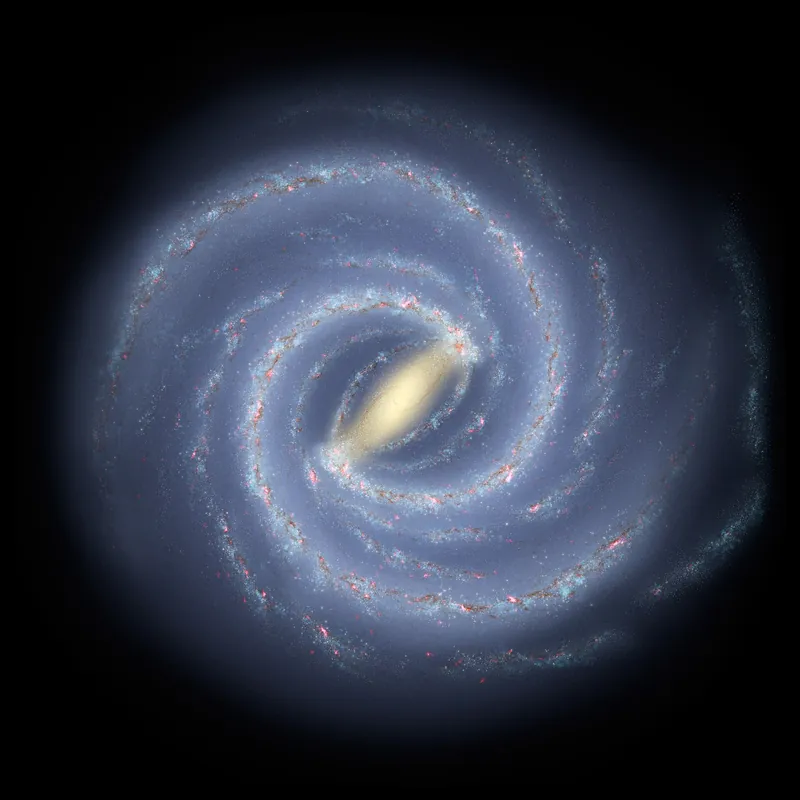
Astronomers agree it is a spiral with a central bar, with arms of stars and gas coming off each end of the bar. Royal Observatory
The bar and the bulge
The bar is roughly 30,000 light-years across. Royal Observatory
The bar wasn’t proven until 2005, when a team used NASA’s Spitzer Space Telescope to survey stars at the centre in infrared light, which gets through the dust. Royal Observatory
The central bulge holds about ten billion mainly old, red stars and is shaped like a peanut. ESA, guide
The bar joins the bulge on two opposite sides, like a pencil skewering a peanut lengthways. Royal Observatory
Two arms or four?
How many major arms? Sources differ
- In 2008 NASA’s Spitzer team found two major arms, Scutum-Centaurus and Perseus, coming off the ends of the bar; before that four major arms had been assumed. NASA, Milky Way map
- Later Gaia star maps gave clear evidence for four arms, an ESA scientist says. ESA, Gaia
- The Royal Observatory names four major arms after the constellations they pass through: Perseus, Scutum-Centaurus, Sagittarius-Carina and Norma/Outer. Royal Observatory
Astronomers have argued about this for decades. NASA’s 2008 Spitzer map found two major arms; later Gaia star maps, and the Royal Observatory, say four.
Most of the galaxy’s stars are born in the nebulae of the arms. Royal Observatory
Arms don’t keep the same stars. ESA’s Jos de Bruijne compares them to traffic jams: stars leave at the front while more pile up at the back. ESA, Gaia
Jan Oort mapped the first hints of the spiral structure with radio observations in the 1950s. ESA, Gaia
Side on
The disc is only about 1,000 light-years thick at the spiral arms, rising to around 10,000 light-years at the central bulge. Royal Observatory
Around the disc is a stellar halo of loose stars and globular clusters, thought to be over 300,000 light-years across but holding only 1% of the stars’ mass. Royal Observatory
There are around 160 known globular clusters in the Milky Way: tight balls of hundreds of thousands to millions of stars. Royal Observatory
The disc is warped, because a ripple is passing through it. Royal Observatory
Our view: “a peanut skewered by a pencil” is the best description of anything in astronomy, and we will be using it at parties.
Next: where we are →