The Local Group, and what happens next
Fifty-odd galaxies, two big ones, and a question mark over the future.
How this site works. Every fact is in our own words and linked to its source, beside it. Where good sources disagree, we show each version in a “Sources differ” box.
The Local Group
The Milky Way sits in a neighbourhood of more than 50 other galaxies called the Local Group. NASA, galaxies
ESA’s Gaia team describes the Local Group as the Milky Way, the Andromeda galaxy and about 60 smaller galaxies. ESA, Gaia 2018
The Local Group lies just off the edge of the Virgo cluster and is part of the Laniakea supercluster. NASA, galaxies
Andromeda
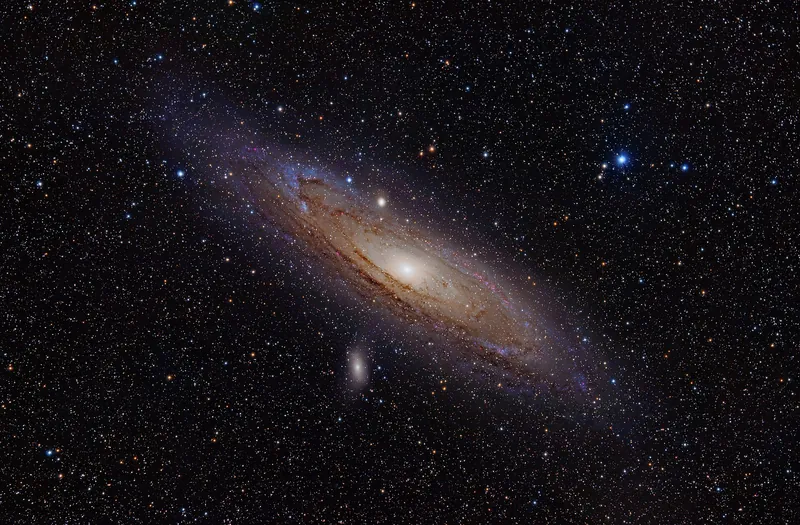
Our nearest large neighbour, the Andromeda Galaxy, is 2.5 million light-years away. Royal Observatory
How big is Andromeda? Sources differ
- The Royal Observatory says Andromeda is about 152,000 light-years wide, with more than twice as many stars as the Milky Way. Royal Observatory
- NASA says Andromeda is some 220,000 light-years wide. NASA, how big
As with the Milky Way, the width depends on where the edge is drawn. Both sources agree Andromeda is the bigger galaxy.
Andromeda is getting about 110 km (70 miles) closer to us every second. Royal Observatory
From the northern hemisphere, under very dark skies, you may see two other galaxies with your eyes alone: Andromeda and M33. Royal Observatory, naked eye
Satellites
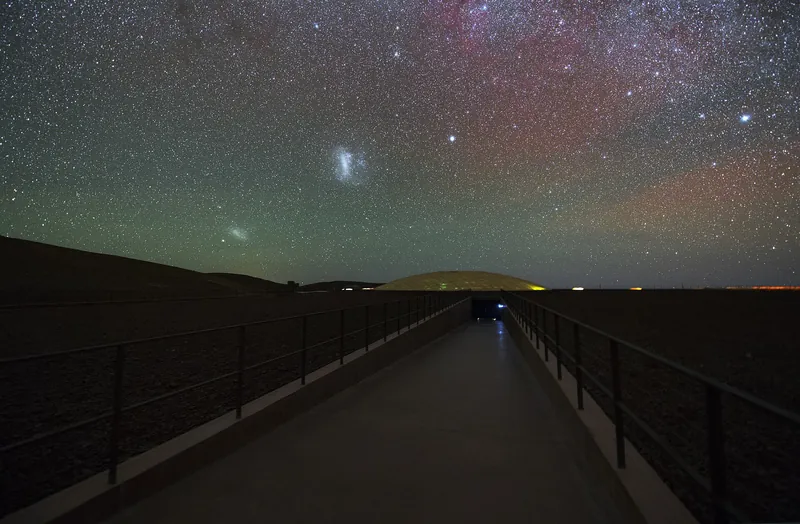
About 60 satellite galaxies are known to orbit the Milky Way, and there may be well over 100. Most are dwarfs, like the Large and Small Magellanic Clouds. Royal Observatory
Britannica gives the Large and Small Magellanic Clouds’ distances as 163,000 and 202,000 light-years. Britannica
The Magellanic Clouds were recognised early in the 20th century as companions of our galaxy. Britannica
The nearest companion, the Sagittarius dwarf galaxy, is falling into the Milky Way, captured by its much stronger gravity; its core is about 90,000 light-years away. Britannica
Gaia found millions of stars moving in a snail-shell pattern in the disc, probably a ripple from a past brush with the Sagittarius dwarf. ESA, Gaia
The Milky Way keeps stripping stars from dwarf galaxies and clusters; Gaia has traced streams of them across the sky. ESA, Gaia
Will we collide with Andromeda?
As far back as 1912, astronomers realised Andromeda, then thought to be only a nebula, was heading our way. NASA, 2025
The future: two studies, two answers
- In 2012 NASA said Hubble measurements predicted a head-on meeting with Andromeda in about four billion years. NASA, 2012
- In 2025 a new study using Hubble and Gaia data found only about a 50-50 chance of the two galaxies colliding in the next 10 billion years. NASA, 2025
- It left only about a 2% chance of a head-on collision in just 4 to 5 billion years. NASA, 2025
The 2025 study used newer data and, importantly, included the uncertainties and the pull of the Large Magellanic Cloud and Triangulum. NASA published both.
The team considered 22 variables and ran 100,000 computer simulations reaching 10 billion years ahead. NASA, 2025
The Large Magellanic Cloud can change the Milky Way’s path and make a collision less likely. ESA/Hubble, 2025
If it does happen
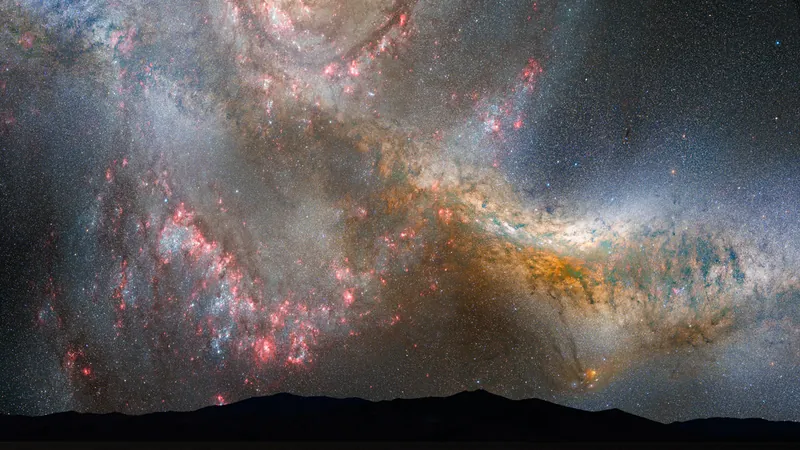
In that picture the two would merge into a single elliptical galaxy about two billion years after the first encounter. NASA, 2012
Stars are so far apart that they would not hit each other, but the Sun would probably be thrown much farther from the centre. NASA, 2012
Andromeda’s small companion, the Triangulum galaxy (M33), would join in and might later merge with the pair. NASA, 2012
The merged galaxy has been unofficially nicknamed Milkomeda. Royal Observatory
NASA points out that a warming Sun will make Earth uninhabitable in roughly a billion years, so Andromeda is the least of our cosmic worries. NASA, 2025
Our view: a 50-50 chance in ten billion years is not something to lose sleep over. The galaxies would not notice the stars inside them passing each other anyway.