Where we are in the Milky Way
In the suburbs, near a small arm, on a 230-million-year merry-go-round.
How this site works. Every fact is in our own words and linked to its source, beside it. Where good sources disagree, we show each version in a “Sources differ” box.
Halfway out
NASA: Earth sits along one of the spiral arms, about halfway from the centre. NASA, galaxies
How far is the Sun from the centre? Sources differ
- The Sun is about 26,000 light-years from the centre, roughly halfway between the centre and the outskirts. ESA, guide
- Royal Observatory: around 26,000 light-years, about halfway out. Royal Observatory
- NASA’s Imagine the Universe: about 25,000 light-years, so we live in the galaxy’s suburbs. NASA Imagine
- Britannica’s summary: about 27,000 light-years. Britannica, summary
All four are round figures from good sources, between 25,000 and 27,000 light-years. The difference is less than one part in ten.
The Orion Arm
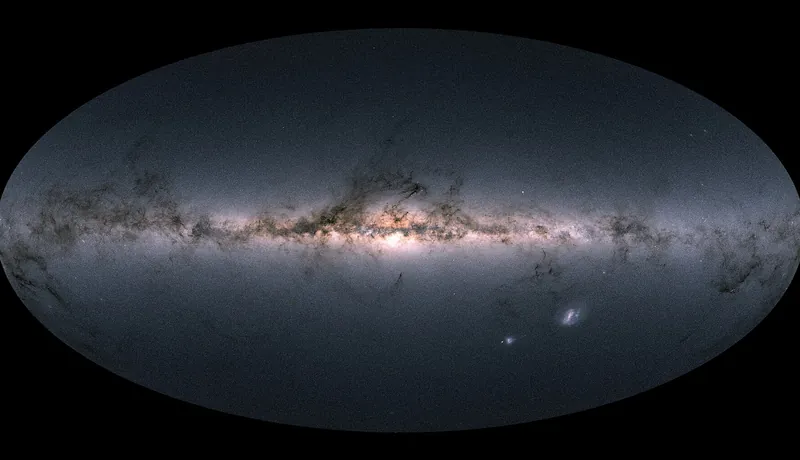
The Sun lies near a small, partial arm called the Orion Arm, or Orion Spur, between the Sagittarius and Perseus arms. NASA, Milky Way map
The Orion Arm is an estimated 20,000 light-years long. Royal Observatory
Most of the stars you can see with your eyes alone are in our own arm, and so are the Orion Nebula and the Pleiades. Royal Observatory
Tilted
The solar system is tilted at about 60 degrees to the galaxy’s disc, which is why the Milky Way crosses our sky at a steep angle to the paths of the planets. Royal Observatory
The galactic year
The solar system travels round the galaxy at about 828,000 km/h (515,000 mph). Royal Observatory
How long is one trip round? Sources differ
- Royal Observatory: one orbit takes about 230 million years, and is called a galactic year. Royal Observatory
- ESA: about 230 million years. ESA, Gaia
- NASA’s galaxy page: about 240 million years. NASA, galaxies
- NASA’s Imagine the Universe: 250 million years. NASA Imagine
The figures run from 230 to 250 million years. They depend on the exact distance and speed used, and both are still being refined.
The disc spins at about 220 km per second. Royal Observatory
As we go round, we bob up and down through the disc, one full bob every 60 to 70 million years. Royal Observatory
The Sun lies about 500 light-years from the Radcliffe Wave, a 9,000-light-year ripple of gas clouds found in 2019, and crossed it about 13 million years ago. ESA, Gaia
Work out how far you have travelled round the galaxy with the galactic odometer.
Our own solar system, the Sun’s family riding along with us, is covered by planets.im: start with Mars or the Moon.
Our view: you have never been in the same place in the galaxy twice. Not once. Not even while reading this sentence.
Next: the centre →